


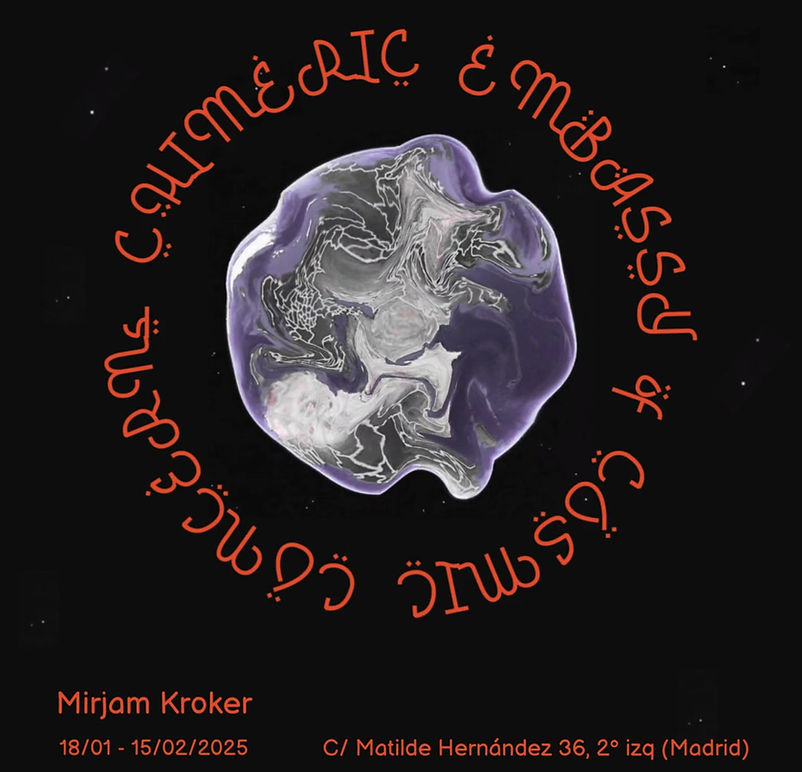
Research Overview (2025-2028) The Chimeric Embassy of Cosmic Concerns is a three-year, drifting inquiry initiated by the artist Mirjam Kroker. It is an experimental space that reimagines diplomacy, ethics (cosmo-ethics), and creativity as processes that critically question the current political regulation of freedom of movement/unfreedom and the right to control life and death of all matter on a militarised planet. Rooted in a hybrid and transformative acknowledgment of both material and immaterial realms, the Chimeric Embassy exists as a living, dynamic space for planetary, cosmic, and interdimensional concerns. It is in a state of constant flux— defies the conventional notion of an embassy as merely political, instead becoming a site for artistic intervention, ontological inquiry, and the negotiation of cosmic concerns. While the Chimeric Embassy operates as an independent and nomadic initiative, it is occasionally sheltered and accompanied by OB Contemporary throughout its trajectory over these three years. In this capacity, OB Contemporary facilitates moments of convergence—conversations, gatherings, collective readings, and exhibitions—that articulate the Embassy’s evolving cosmic concerns. As a periodic host and collaborator, OB Contemporary provides temporary refuge while advocating the Chimeric Embassy of Cosmic Concerns to remain open across geographies, embracing an ever-shifting constellation of alliances. Over the course of its journey, the Chimeric Embassy will activate diverse sites and semi-institutions, creating spaces for gatherings, exhibitions, and activations across varied contexts. The Chimeric Embassy of Cosmic Concerns arises from the acknowledgment that the cosmos, in all its vastness, encompasses concerns that stretch far beyond human understanding yet are deeply entangled with human and more than human existence. Its gesture is to initiate altered conversations across cosmic boundaries, where matters, energies, and thoughts intersect in ever-shifting, hybrid constellations. The Chimeric Embassy of Cosmic Concerns begins here: in the murmured resonances of planetary aesthetics and cosmo-ethics. It is not a fixed place but an intersympathetic practice, an emergent cosmopublic site where whispers turn into spirals, and spirals become bridges. Here, Earth is not just the ground to walk upon but a resonant body, a breathing entity with symbiotic currents that call each and everyone to attention. The Embassy listens to these calls, weaving interdimensional bridges of care and connection, inviting a shift—a spiraling shift—toward recognizing Earth not as an object to regulate but as a living, legal subject with infinite affinities. It is through these whispered links and echoed entwining that it is to unlearn extractive ways of being. How might a cosmopublic practice rooted in such resonant weavings invite a reimagining of borders, governance, and the ethics of movement? How might trans-connections and intracuriosities begin to disassemble systems that deny Earth its rightful place as a subject of rights? The Chimeric Embassy does not answer. It dreams. It spirals. It hosts. It gathers voices, stitching synaptic ties between disciplines, between the seen and unseen, between the human and the more-than-human. A shimmering gathering of serendipitous alignments emerges, soft yet urgent, asking to reorient our imaginations toward planetary solidarities. This is a cosmo-ethical provocation: a call for infinite embraces among all matter, a shared ontology of care that recognizes the agency of Earth and its materiality. A planetary art that signals the urgent need for a habitable future, one woven from whispering links, symbiotic currents, and friendly solidarities across all existence. The Chimeric Embassy, nomadic and unfixed, invites you to step into its resonant orbit. Not to resolve but to echo, not to solve but to weave—to build a planetary art where aesthetics and ethics collapse into one shimmering, spiraling, serendipitous embrace. This is cosmo-ethics, and this is where it begins.

CHIMERIC EMBASSY OF COSMIC CONCERNS
As I see it, the radicality of manifestation lives in a liminal space—something that floats between the rigor of science, the expressiveness of art making, and the expansiveness of all that escapes categorisation. My path through anthropology was fueled by a relentless drive to ask questions, a hunger for understanding life in all its pluriversality. But, ironically, the scientific impulse to claim definitive knowledge often veils other ways of being, suppressing modes of existence that defy objectivity. Anthropology, which positions itself still often as an authority on "otherness," if so, ends up reducing lived experiences to something evaluable, something manageable. This approach is, in a way, colonial; it dictates what qualifies as "truth" and discards all else.
My shift to art arose from a desire to communicate without that implicit arrogance, to transmit my experience and understanding with openness rather than sovereignty. Art-making allows me to radiate what I perceive in ways that resist fixation—gentler, subtler, even more ambiguous. It doesn’t impose itself; rather, it extends a hand, invites a shared gaze, and allows for interconnection without the need to classify or judge. The act of creation here is relational, evolving, rooted in coexistence rather than analysis.
This is why I ultimately stepped away from the academic gaze that anthropology often holds so tightly. Science demands solutions, it claims understanding, but there are layers of reality, of feeling, that remain untouched by its reach. Art, on the other hand, values the form, the movement, the radiance of thought beyond its content. It invites me to explore not merely what I understand, but how I express and embody that understanding, how I shape it into something others might inhabit with me.
To communicate is, then, to connect—to craft a language that extends rather than confines, that radiates possibility rather than asserting fixed truths. I seek this in art not as a means of representation, but as a way to inhabit and share the world, humbly, creatively, and in an endless, transitioning polylog with all that coexists.