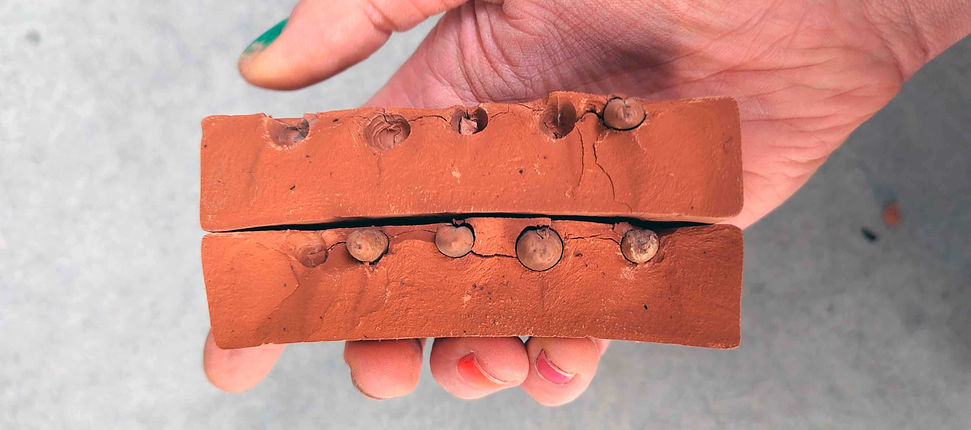
Non-Permanent Documentation Units Hosting Latent Organisms, 2025, air-tried clay, seeds, planet earth
This work in progress examines unfired clay as a material of storage whose historical significance is deeply rooted in the emergence of political and administrative systems. Since the third millennium BCE, clay—shaped, dried, or fired—served as a primary medium through which early states recorded laws, contractual relations, and economic governance. The earliest known legal codes, including the Ur-Nammu Code and later the Code of Hammurabi, were inscribed on clay tablets and formed the basis of juridical stability in Mesopotamian societies. Extensive cuneiform archives from Ebla, Mari, Amarna, and the library of Ashurbanipal include treaties, diplomatic correspondence, population records, scientific writings, and administrative inventories. Clay thus functioned not merely as a material substrate but as an instrument of political fixity.
Alongside this legal-administrative tradition exists a second, less formalized but equally relevant history: clay has long been used to protect and transport seeds. From neolithic clay capsules to agrarian practices in Mesopotamia, the Indus Valley, and parts of Mesoamerica, unfired or lightly dried clay served as a container for biological matter—shielding it from moisture, pests, and environmental fluctuation. In this dual use—codifying governance and safeguarding ecological potential—the material embodies the intersection of political power and environmental continuity.
Working with unfired clay in this artwork deliberately repositions the historical logic of the medium. Whereas ancient legal cultures stabilized the tablet’s authority through firing, here the clay remains structurally open: sensitive to humidity, erosion, pressure, and time. This shifts inscription away from permanence toward a mode of temporal permeability. The objects do not represent closed documents but forms continually negotiating their relation to environmental conditions.
A subset of the clay volumes contains seeds. This choice does not claim novelty; rather, it acknowledges and reactivates an existing historical function of the material. Yet, in this context, the purpose is not preservation but the operationalization of instability. As the clay decays, the relation between carrier and content transforms: the archive becomes active through its own dissolution. The seeds are not symbolic gestures but material agents participating in the reconfiguration of the object.
The multilingual inscription pressed into each clay surface addresses contemporary questions of global mobility and forms of belonging. Historically, clay tablets legitimized territorial control, legal identity, and the administration of rights. Here, the inscription gains its meaning not through the durability of the medium but through its opposite: the text gradually loses legibility as the clay breaks down. Inscription becomes an interim gesture, contingent on environmental conditions rather than state structures. It resists serving as identification, certification, or declaration.
Through this material and structural repositioning, the work examines how matter itself participates in shaping political and epistemic order. It demonstrates that unfired clay—long tied to the stabilization of authority—can instead generate forms of meaning grounded in change, exposure, and incompleteness. Its fragility is not a deficit but a method.
From this perspective, the work suggests a conception of art that does not rely on permanence but on how materials articulate conditions of movement, relation, and planetary interdependence. Meaning emerges not from fixity but from the object’s capacity to continually renegotiate its place within ecological, social, and political configurations.