top of page
Volumen-suave-de-un-organismo-latente_mirjam-kroker.jpg

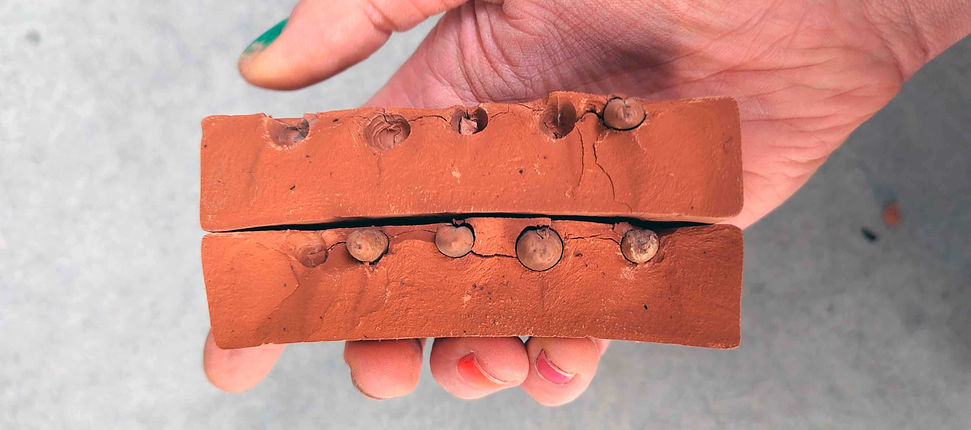
Non-Permanent Documentation Units Hosting Latent Organisms, 2025, air-tried clay, seeds, planet earth

This work in progress examines unfired clay as a material of storage whose historical significance is deeply rooted in the emergence of political and administrative systems. Since the third millennium BCE, clay—shaped, dried, or fired—served as a primary medium through which early states recorded laws, contractual relations, and economic governance. The earliest known legal codes, including the Ur-Nammu Code and later the Code of Hammurabi, were inscribed on clay tablets and formed the basis of juridical stability in Mesopotamian societies. Extensive cuneiform archives from Ebla, Mari, Amarna, and the library of Ashurbanipal include treaties, diplomatic correspondence, population records, scientific writings, and administrative inventories. Clay thus functioned not merely as a material substrate but as an instrument of political fixity.

Alongside this legal-administrative tradition exists a second, less formalized but equally relevant history: clay has long been used to protect and transport seeds. From neolithic clay capsules to agrarian practices in Mesopotamia, the Indus Valley, and parts of Mesoamerica, unfired or lightly dried clay served as a container for biological matter—shielding it from moisture, pests, and environmental fluctuation. In this dual use—codifying governance and safeguarding ecological potential—the material embodies the intersection of political power and environmental continuity.

Working with unfired clay in this artwork deliberately repositions the historical logic of the medium. Whereas ancient legal cultures stabilized the tablet’s authority through firing, here the clay remains structurally open: sensitive to humidity, erosion, pressure, and time. This shifts inscription away from permanence toward a mode of temporal permeability. The objects do not represent closed documents but forms continually negotiating their relation to environmental conditions.

A subset of the clay volumes contains seeds. This choice does not claim novelty; rather, it acknowledges and reactivates an existing historical function of the material. Yet, in this context, the purpose is not preservation but the operationalization of instability. As the clay decays, the relation between carrier and content transforms: the archive becomes active through its own dissolution. The seeds are not symbolic gestures but material agents participating in the reconfiguration of the object.

The multilingual inscription pressed into each clay surface addresses contemporary questions of global mobility and forms of belonging. Historically, clay tablets legitimized territorial control, legal identity, and the administration of rights. Here, the inscription gains its meaning not through the durability of the medium but through its opposite: the text gradually loses legibility as the clay breaks down. Inscription becomes an interim gesture, contingent on environmental conditions rather than state structures. It resists serving as identification, certification, or declaration.

Through this material and structural repositioning, the work examines how matter itself participates in shaping political and epistemic order. It demonstrates that unfired clay—long tied to the stabilization of authority—can instead generate forms of meaning grounded in change, exposure, and incompleteness. Its fragility is not a deficit but a method.

From this perspective, the work suggests a conception of art that does not rely on permanence but on how materials articulate conditions of movement, relation, and planetary interdependence. Meaning emerges not from fixity but from the object’s capacity to continually renegotiate its place within ecological, social, and political configurations.

semillaspaper.png

UNBURY TOMORROW: Against the Normalisation of War is a variable installation
composed of printed micro-essays (multilingual, free for circulation), a portable analogue television
(Tele Star 4004, late 1980s), a telescopic antenna, a white textile, plastic and electricity.

The installation is variable in scale, approximately 250 × 130 × 120 cm.

UNBURY TOMORROW: against the normalisation of war, constitutes the second public occurrence within
Chimeric Embassy of Cosmic Concerns (2025–2028), a semi-nomadic research project initiated by Mirjam Kroker.
The project unfolds through invitations from institutional, semi-institutional, and independent spaces,
forming temporary assemblies and shared inquiries.

UNBURY TOMORROW: against the normalisation of war unfolds from the recognition that war is not an exceptional rupture of order, but a recurrent power logic through which order itself is produced and maintained. Historically, war has structured the world through cycles of conquest, destruction, repair, reconstruction, and renewed militarisation. These cycles are reproductive. They generate infrastructures, industries, political vocabularies, and aesthetic regimes that stabilise power while rendering violence necessary, manageable, and legitimate.

Within this logic, war does not need to declare itself. It operates as an atmospheric condition—shaping perception, affect, and time. Its visual languages are deeply sedimented: images of damage, restoration, resilience, and post-conflict repair circulate with strong aesthetic force. Contemporary art and critical practices are not outside this economy; they are often drawn into reproducing its grammars, even when opposing its outcomes.

UNBURY TOMORROW does not seek to counter this condition with alternative images or representations. Instead, it acknowledges the persistence of this power logic and withdraws from its modes of production. The work refuses the aesthetic operations through which war renders itself intelligible, 'attractive', and culturally operative. The installation consists of multiple elements arranged horizontally. None of them functions as a centre. This lack of hierarchy is deliberate. Centrality reassures; it stabilises meaning. It mirrors the logics of targeting, focus, and command that structure militarised perception. By refusing a centre, the work resists the comfort of orientation and the expectation that meaning must be anchored in a dominant object.

A portable analogue television, Tele Star 4004, is present among the elements. Designed for terrestrial signal reception, the device no longer receives any broadcast. Its screen flickers continuously, producing electronic noise without legible image. The words UNBURY TOMORROW are handwritten directly onto the glass surface. This flicker is not an absence of image, but an image rendered unreadable. The refusal to repair or replace interrupts the familiar cycle of damage and restoration—a cycle deeply aligned with the temporal logic of war, in which destruction is followed by repair, reconciliation, and renewed violence. By remaining unresolved, the device withdraws from productivity, resolution, and narrative completion.

Attached to the television’s telescopic antenna is a white cloth. The configuration frequently evokes the image of a flag. This reading is neither accidental nor corrected. It functions as a moment of exposure. The immediacy with which the cloth is perceived as a flag reveals how deeply perception is trained by sovereign and militarised aesthetics—how quickly fabric, elevation, and visibility are associated with territory, allegiance, and security politics. The cloth, however, is not a flag. The antenna is not a flagpole. The antenna no longer receives signals; it does not transmit messages or claim ground. It has been repurposed into a support without function or designation. In this misrecognition, viewers might encounter their own habituation to the aesthetic value of power and the visual attraction of war’s ordering forms.

Equally present are the micro-essays, printed in Spanish, English, and Spanglish, and currently being translated into Arabic and Hebrew. These texts are made available for free circulation. They do not explain the installation. They move alongside it.

Their circulation from hand to hand, rather than from screen to screen, follows a different historical logic of transmission. Hand-to-hand circulation is slow, contingent, and relational. It depends on proximity and trust rather than speed, scalability, or control. It resists the militarised infrastructures of contemporary media, which privilege surveillance, optimisation, and algorithmic reach. The texts do not produce visibility metrics, data traces, or stable archives. Circulation here is understood as companionship rather than dissemination.

UNBURY TOMORROW does not name an alternative condition or offer a reconciliatory horizon. Instead, it opens a field of questioning:


How might perception be loosened from militarised habits of seeing?
How might language be relieved from the pressure to justify, secure, or stabilise?
How might one begin to live otherwise, without transforming uncertainty too quickly into answers?

These questions are not posed from a position of certainty. They are part of the work’s own hesitation. The installation does not instruct; it attends. It remains with the difficulty of recognition, with the unease of not knowing how interruption might look or feel.

In this sense, UNBURY TOMORROW operates as an insurrection at the level of perception—not through confrontation, but through attentiveness. An insurrection that does not overthrow, but subtly disorients; that does not declare, but circulates; that does not resolve, but stays present with the conditions that make resolution appear necessary.

bottom of page